
Home >> News >> Company News >>
In industrial projects, the cable purchase often represents only a small fraction of the total investment. But a single failure caused by incorrect cable selection – short circuit, insulation breakdown, full batch replacement – can lead to dozens of times that amount in downtime and repair costs.
We frequently receive questions like these from purchasers:
● “My supplier says both THHN and XHHW will work, so why is there a large price difference?”
● “Our equipment is installed in a steam‑filled workshop. The previous THHN cables cracked after two years – what should we use instead?”
● “For a control panel exported to the US, which cable type should be labelled on the UL tag?”
This technical document eliminates vague sales language. Based solely on UL 83, UL 44, UL 1581 standards and material engineering principles, we objectively compare THHN and XHHW cables. After reading, you will be able to:
● Understand the core material differences between the two conductors
● Choose the right cable based on temperature, humidity, chemical exposure, and mechanical stress
● Calculate the total cost of ownership (TCO)
1. Basic Definitions & Standard References
Feature | THHN | XHHW |
Full name | Thermoplastic High Heat-resistant Nylon-coated | Cross-linked Polyethylene High Heat-resistant Water-resistant |
Insulation material | PVC + Nylon jacket (thermoplastic) | Cross-linked polyethylene (XLPE) (thermoset) |
Applicable standards | UL 83, UL 758 | UL 44, UL 1685 |
Temperature rating – dry location | 90°C | 90°C (XHHW-2 = 90°C) |
Temperature rating – wet location | 75°C | 90°C (XHHW-2) |
Water resistance | Limited (nylon layer absorbs moisture → dielectric loss) | Excellent (XLPE is hydrophobic) |
Oil / chemical resistance | Fair (PVC is not resistant to hydrocarbon solvents) | Good (cross linking improves chemical resistance) |
Flame rating | VW-1 (UL 1581) | VW-1 / FT4 optional |
Typical applications | Building wire, dry conduits, internal machine wiring | Wet/underground/outdoor locations, industrial power distribution, power plants |
Important note: Traditional THWN is the wet‑location version of THHN (75°C wet). Today, most THHN cables are also dual‑rated as THWN (because they meet UL 83 requirements). However, even THWN is limited to 75°C in wet locations, whereas XHHW‑2 can be used at 90°C wet. This is the most fundamental performance difference.
2. In‑Depth Technical Comparison (Must‑Read for Purchasers)
2.1 Insulation Material & Temperature Limits
THHN - PVC + Nylon structure:
The nylon layer provides excellent abrasion resistance and lubricity (easy pulling through conduit). However, PVC accelerates plasticizer migration under high temperature and humidity, leading to hardening and cracking. Under long‑term exposure to wet‑heat above 80°C, service life is significantly shorter than XLPE.
XHHW - Cross-linked polyethylene:
Through chemical or radiation cross‑linking, polyethylene chains form a three‑dimensional network. This thermoset material does not melt and remains dimensionally stable up to 150°C. It is also highly hydrophobic. This is why XHHW achieves 90°C wet‑location rating.
Engineering data:
According to ICEA (Insulated Cable Engineers Association) standards, under the same 90°C wet condition, the thermal aging life of XLPE insulation is 2.5 to 3 times longer than PVC/Nylon.
2.2 Chemical & UV Resistance
Environmental factor | THHN | XHHW |
Mineral / hydraulic oil | Swelling, cracking | Good (check specific grade) |
Weak acids / alkalis | Fair | Good |
Ozone | Poor | Excellent |
Direct sunlight (UV) | Poor (requires extra jacket or conduit) | Good (black XLPE is inherently UV-resistant) |
Purchasing advice: If cables must be exposed to oily mist (e.g., stamping or hydraulic shops) or installed outdoors without conduit, XHHW-2 (or variants with CPE jacket) should be the first choice.
2.3 Installation Flexibility (Bend Radius & Pulling Tension)
THHN: Low friction nylon jacket makes pulling easier in conduits – suitable for long straight runs. Minimum bending radius ≈ 5–8× outer diameter.
XHHW: Higher surface friction but better flexibility (especially with fine strands). Minimum bending radius ≈ 4–7× outer diameter. For repeated flexing (cable carriers), XHHW offers superior flex life.
Rule of thumb:
Long straight conduit runs → THHN has an advantage
Multiple bends, tight spaces, or moving applications → XHHW is better
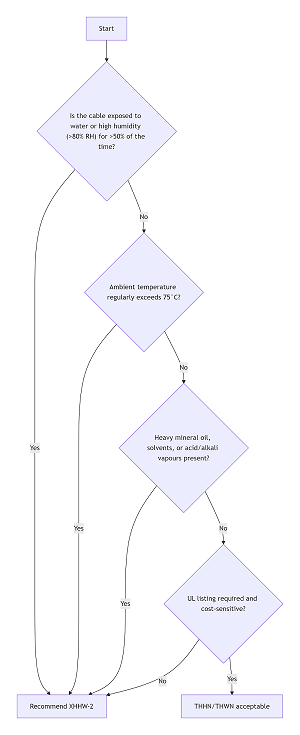
3. Decision Tree for Cable Selection (with Real‑World Scenarios)
The following decision tree is based on feedback from actual projects. Answer the questions in order to get the recommended cable type.
inquiry

