
Home >> News >> Company News >>
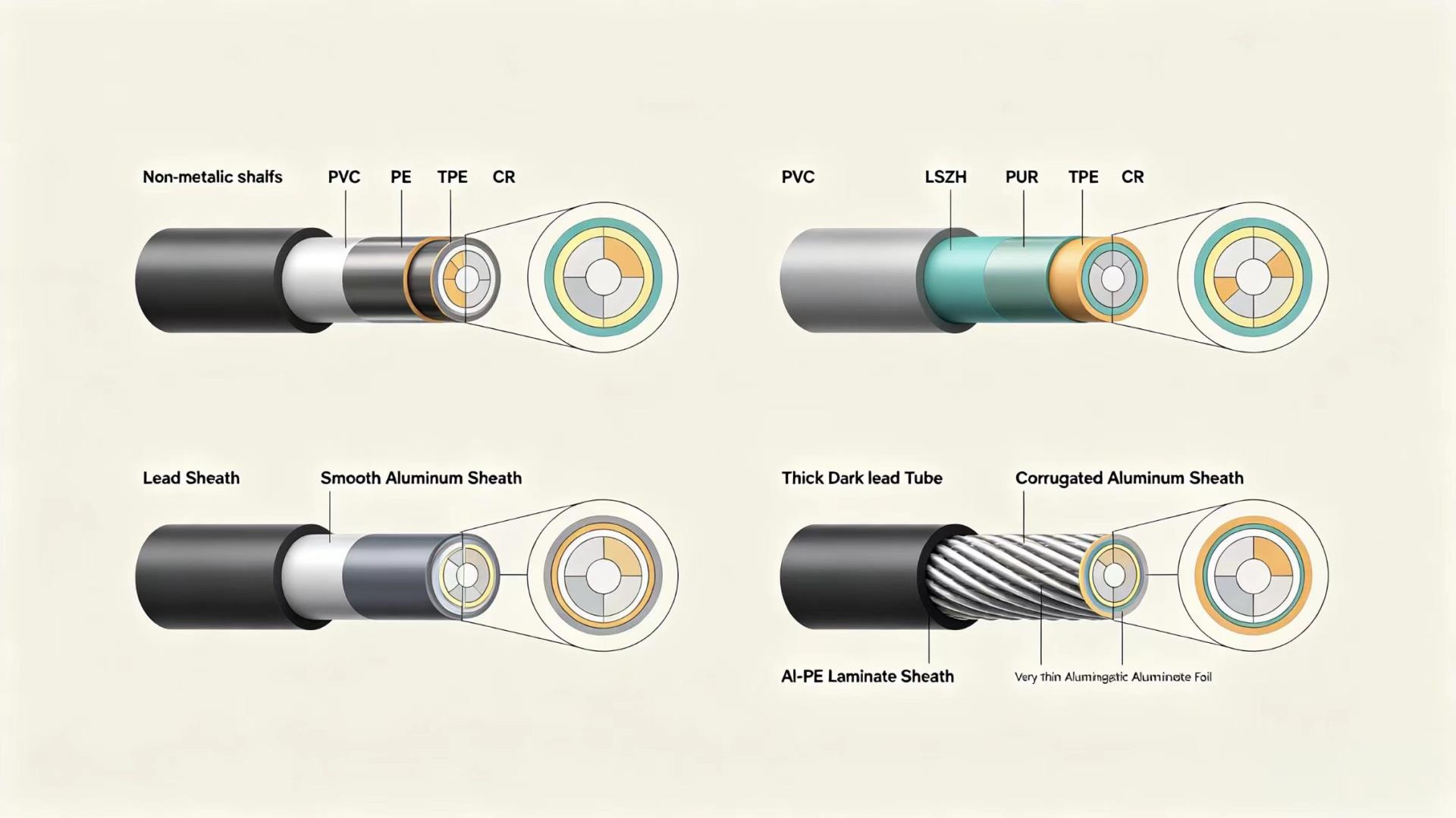
You‘re sourcing high voltage cable for a direct burial project. Supplier A quotes lead sheath. Supplier B quotes aluminium sheath. The price difference is nearly 20%. Both say their product “meets the standard.”
Which one fits your project?
This guide breaks down the key differences between sheath types and helps you decide based on your specific project conditions.
The metal sheath is the metallic layer over the cable insulation. It serves two essential functions:
1.Radial water barrier: Prevents moisture from penetrating the XLPE insulation. Once water enters, it forms “water trees“ inside the insulation — gradually degrading performance until eventual breakdown.
2.Short-circuit current path: Provides a return path for zero-sequence short-circuit current. The sheath must have sufficient thermal stability to withstand fault current without damage.
In short: the metal sheath is both a waterproof layer and a safety device.
In current power systems, six metal sheath types are in use. They fall into three manufacturing categories: extruded seamless metal sheaths, longitudinally welded metal sheaths, and composite sheaths.
Manufacturing: Extruded seamless continuous lead tube via continuous lead press.
Key advantages:
● Excellent corrosion resistance — chemically stable against acids and alkalis. If the outer jacket is damaged, the lead sheath won‘t perforate quickly. This is a decisive advantage in submarine cable applications.
● Flexible and easy to install — lead-sheathed XLPE cables are more flexible during laying than aluminium-sheathed ones. Solder-wiping in jointing is straightforward.
● Superior longitudinal water-blocking — no internal clearance gaps needed, providing a tight structure.
● Accommodates insulation expansion — when the XLPE insulation expands due to heat, it can stretch the lead sheath without leaving corrugation marks on the insulation surface.
Key limitations:
● Heavy — lead density is 11.34, 4.2 times that of aluminium. For a 110kV 1×630mm² cable, the lead sheath is typically 4mm thick versus 2mm for aluminium. Jicable data shows for a 1200mm² Al 90kV cable, lead sheath cable weighs 13.6 kg/m compared to 7.5 kg/m for aluminium sheath — a weight reduction of over 40%.
● Low mechanical strength — unsuitable for installations subject to vibration or high compression.
● Low short-circuit thermal stability — lead‘s electrical resistivity is significantly higher than aluminium.
● Scarce and toxic — less available, more expensive, and environmentally problematic.
In short: In wet, corrosive, or underwater environments, lead sheath offers the highest reliability — at the cost of weight and material expense.
Manufacturing: Extruded aluminium tube via continuous or non-continuous aluminium press, then corrugated.
Key advantages:
● Lightweight — aluminium density is only about a quarter of lead. Weight savings of 40% or more compared to lead sheath.
● High mechanical strength — aluminium‘s mechanical strength is approximately 5 times that of lead.
● Good conductivity — low DC resistance, high short-circuit current capacity.
● May eliminate armour — the corrugated aluminium sheath provides excellent crush resistance, potentially eliminating the need for additional armouring.
Key limitations:
● Lower corrosion resistance — aluminium is chemically active and susceptible to galvanic corrosion. If the outer jacket is damaged, aluminium perforates quickly in moist environments.
● Less flexible and harder to seal — aluminium is less pliable, making sealing during accessory installation more challenging.
● Larger diameter and shorter drum lengths compared to lead sheath.
In short: The preferred choice for land installations — weight and cost advantages are clear, but it cannot be used in underwater or highly corrosive environments.
Manufacturing: Aluminium strip rolled and longitudinally welded, then corrugated.
Key advantages: Essentially the same performance as seamless aluminium sheath, with higher manufacturing efficiency.
Key limitations: Contains a longitudinal weld seam. While modern welding processes ensure reliable quality, the weld area remains a potential weak point.
In short: Suitable for cost-sensitive land projects, but verify the supplier‘s weld quality validation capability.
Manufacturing: Copper strip rolled and longitudinally welded, then corrugated.
Key advantages: Excellent conductivity and high thermal stability; lighter than lead sheath.
Key limitations: Difficult weld process control — arc drift can cause weld defects or copper droplets; larger diameter and higher cost.
In short: Suitable for special projects with extreme short-circuit thermal stability requirements, but cost and process complexity limit widespread application.
Manufacturing: Stainless steel strip rolled and longitudinally welded, then corrugated.
Key advantages: High mechanical strength, excellent corrosion resistance.
Key limitations: Lower thermal stability than copper; larger diameter; highest cost.
In short: Only recommended for highly corrosive land environments — cost-effectiveness is limited in other scenarios.
Manufacturing: Aluminium foil PE laminate longitudinally lapped and hot-air welded.
Key advantages: Lightweight, simple construction, lowest cost.
Key limitations: Poor sealing integrity. The laminate thickness is thin (typically 0.15-0.20mm), and overlaps inevitably have defects. Creasing or rupture can occur during installation.
In short: Only suitable for dry, low-risk indoor environments such as tunnels and cable chambers.
Note: Seamless lead sheath and seamless corrugated aluminium sheath are the two most common options in international procurement. The remaining types (welded aluminium/copper/stainless steel, composite) are used in specific niche applications.
● High thermal stability requirement (e.g., substation feeders): copper or aluminium sheath outperforms lead
● Lead‘s resistivity is significantly higher than aluminium. For the same fault current, lead sheath requires substantially more cross-section than aluminium
● If the technical specification requires a long short-circuit duration, lead sheath cables may need additional copper wire shielding beneath the lead — substantially increasing cost
● Weight-sensitive (long-distance, vertical runs, bridges): corrugated aluminium offers clear advantages
● Weight-insensitive: lead sheath is a reliable choice
A practical reference: Jicable data shows for a 1200mm² Al 90kV cable, lead sheath cable weighs 13.6 kg/m compared to 7.5 kg/m for aluminium sheath — a weight reduction of over 40%. In long-distance projects, this translates directly into transport cost, support structure cost, and installation difficulty.
CN Cable Group manufactures high voltage cables at 66kV, 110kV, and 220kV voltage levels in accordance with IEC 60840/62067 standards.
Our high voltage cable range includes:
Each cable can be manufactured with different metal sheath options .
View related product catalogs:
https://www.cncablegroup.cn/products/mv-hv-power-cables/page/2/
1. Which is more expensive — lead sheath or aluminium sheath?
Lead metal itself is cheaper per tonne than aluminium. However, lead sheath requires 2-3mm thickness versus 0.5-1mm for aluminium on the same cable, and lead is 4.2× denser. For a 1200mm² Al 90kV cable, lead sheath weighs 13.6 kg/m versus 7.5 kg/m for aluminium. If additional copper shielding is required under the lead for short-circuit thermal stability, the cost gap widens further.
2. Why is lead sheath mandatory for submarine cables?
Submarine cables face high risk of anchor damage, and repair is extremely difficult. Aluminium sheath perforates quickly in seawater if the outer jacket is damaged. Lead sheath resists corrosion and will not perforate quickly even if the jacket is breached.
3. Can aluminium sheath cables be used without armour?
Yes. The corrugated aluminium sheath provides excellent crush resistance, which can eliminate the need for additional armouring.
4. Why is lead-sheathed cable softer than aluminium-sheathed cable?
Lead has better creep properties, making lead-sheathed XLPE cables more flexible during installation. However, aluminium‘s mechanical strength is approximately 5 times that of lead.
For project-specific enquiries or to request sheath type recommendations based on your installation environment, please contact us:
Tel: +86-371-6054 7601
WhatsApp / WeChat: 0086 135 9887 3045
Email: Admin@cncablegroup.com
inquiry

