
Home >> News >> Company News >>
MV cable selection errors are less forgiving than LV. A single 11kV termination failure can release explosive energy, damaging adjacent equipment and creating safety hazards. In one documented case, a cable specified to European installation standards was installed in 95% humidity and corrosive soil in Southeast Asia. The armour corroded through in 18 months, causing a cascading earth fault that shut down a $200 million industrial facility for six weeks. The root cause was not a defective cable — it was a mismatch between the selected product and the actual installation environment. This article examines five common MV cable failure modes, each linked to verifiable product parameters and procurement verification methods.
Failure Mode | Core Product Parameters | Key Standards | Procurement Verification |
Installation damage | Armour type, sheath material, bending radius | IEEE 1185-2019, IEC 60502-2 | Request bending radius and pulling tension limits |
Joint failure | Accessory type test, PD data | IEEE Std 48 | Request combined cable + accessory test report |
Water treeing | Insulation type (TR-XLPE) | ASTM D6097 | Request water tree growth test data |
Partial discharge | PD factory test value | IEC 60502-2 clause 18.2.5 | Request per-drum PD report (≤5pC at 1.5U₀) |
Metallic screen corrosion | Armour material (AWA/SWA) | IEEE 1142-2025 | Request corrosion test or similar project records |
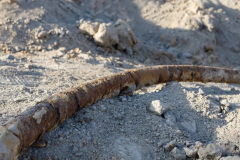
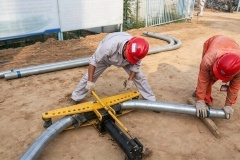
Mechanism: IEEE 1185-2019 states that installation damage is the single greatest cause of wire and cable failures. Common installation damage includes excessive bending, excessive pulling tension, sharp edge abrasion, and backfill stones. Damage may not be immediately visible but becomes an initiation point for insulation breakdown during operation.
Product parameters and standards: Armour type (STA/SWA/AWA) and sheath material (PVC/PE/LSZH) must match the installation environment. IEC 60502-2 specifies minimum bending radius requirements.
What it means for procurement: If a supplier cannot provide minimum bending radius data, the risk of installation damage cannot be assessed.
Installation Environment | Recommended Armour | Recommended Insulation | Reason |
Direct burial (normal soil) | SWA/STA | TR-XLPE (wet environments) | Mechanical protection + water tree resistance |
Coastal / chemical | AWA | TR-XLPE or EPR | Non-magnetic, corrosion resistant |
Tunnel / cable tray | STA | XLPE or TR-XLPE | Cost optimisation, no corrosion risk |
Underwater / wet | AWA + metallic sheath | TR-XLPE | Radial water blocking + water tree resistance |
Mechanism: Industry data shows that 70% of cable failures originate from accessories (joints and terminations). Causes include poor workmanship, insufficient interface pressure, and thermal runaway. A September 2026 IEEE study found that summer joint temperatures are 10–15°C higher than surrounding soil, potentially activating partial discharge in microvoids and leading to sudden breakdown.
Product parameters and standards: IEEE Std 48 specifies MV termination testing requirements. Accessories must pass type tests together with the cable.
What it means for procurement: If a supplier only provides a cable body test report and no accessory system test data, system risk is uncontrolled.
Mechanism: Moisture ingress into XLPE insulation forms water trees under the electric field. These grow into electrical trees and eventually cause breakdown. TR-XLPE (tree-retardant XLPE) is specifically designed to inhibit water tree growth.
Product parameters and standards: Dow ENDURANCE™ 4202 technical data shows TR-XLPE water tree growth of 0.288mm versus 1.209mm for standard XLPE (ASTM D6097) — a 76% reduction. EPRI research concludes that TR-XLPE cable life exceeds 40 years. ASTM D6097 is the relevant test standard.
What it means for procurement: In wet environments, TR-XLPE insulation can extend the replacement cycle from 15–20 years to over 40 years.
Mechanism: Voids, contaminants, or semiconductive layer protrusions cause local electric field concentration, leading to partial discharge (PD). PD erodes the insulation and gradually develops into breakdown. PD affects 30% of MV cables over 20 years old, and 40% of outages originate from insulation issues.
Product parameters and standards: IEC 60502-2 clause 18.2.5 specifies PD test requirements. IEC 60502-4 requires factory test PD ≤10pC; IEEE and ICEA require ≤5pC.
What it means for procurement: PD test data is the most direct quantitative basis for insulation quality — not just a pass/fail conclusion.
Mechanism: Metallic screens or armour layers corrode in wet, corrosive soil or coastal environments, reducing field control capability. In the case cited earlier, the armour corroded through in 18 months due to a metallurgical mismatch with the environment.
Product parameters and standards: AWA (aluminium wire armour) is non-magnetic and more corrosion-resistant in coastal and chemical environments. SWA performs well in normal soil but requires extra protection in high salt spray. IEEE 1142-2025 provides guidance for water barrier design.
What it means for procurement: Selecting armour material based on the soil corrosion level is safer and more economical than defaulting to SWA.
Item | Prevention Cost | Failure Cost |
Insulation material | TR-XLPE is 10–15% more expensive than standard XLPE | Replacing a cable section costs 5–10 times the purchase price |
Armour material | AWA is 12–20% more expensive than STA | Corrosion penetration requires excavation and replacement, with major downtime |
Testing verification | Additional PD testing adds about 2–3% to cost | No PD data leads to acceptance failure or in-service breakdown |
Accessory system | Supplying matched accessories adds minor cost | Accessory failures account for 70% of cable failures |
In our export projects, cables installed in wet environments without TR-XLPE insulation have shown noticeably higher replacement frequency than those using TR-XLPE.
Tel: +86-371-6054 7601
WhatsApp / WeChat: 0086 135 9887 3045
Email: Admin@cncablegroup.com
Previous : The Impossible Triangle of Low Voltage Cables: Cold Flexibility, Flex Life, and LSZH
NEXT : none
inquiry

