
Home >> News >> Company News >>
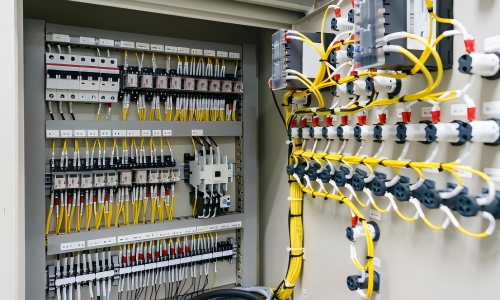
Picture this: The electrical drawing specifies an N2XY cable. But when the installation crew tries to route it inside a crowded switchgear cabinet or connect it to a vibrating skid-mounted motor, the cable just won’t bend enough. The crew forces it into a tight 90-degree corner to make it fit.
Short answer: That forced bend is a physical compromise. N2XY is designed for straight runs; forcing it below its 12x overall diameter (OD) bending radius puts mechanical stress directly on the XLPE insulation. RV-K, built with an IEC 60228 Class 5 conductor, cuts that bending limit down to 5x OD. It’s not about paying more—it’s about matching the cable's physical limits to the actual installation space.
According to standard IEC 60502-1, a multicore N2XY cable requires a minimum bending radius of 12 times its outer diameter. This isn’t just a recommendation for installer convenience; it’s the physical limit before the insulation starts to strain.
When a rigid N2XY conductor is bent too tightly, the outer copper strands are stretched while the inner strands are compressed. Because the wires inside a Class 2 conductor are relatively thick, they can’t slide past each other to relieve this stress. That mechanical force is transferred directly to the XLPE insulation wall.
Even if the cable doesn't break during installation, this creates microscopic weak points. In the long run, moisture and electrical load can exploit these stress points, leading to unexpected insulation failures and equipment downtime.
RV-K isn't just a premium version of N2XY. It solves the bending problem through its internal structure. Under IEC 60228, the RV-K uses a Class 5 conductor.
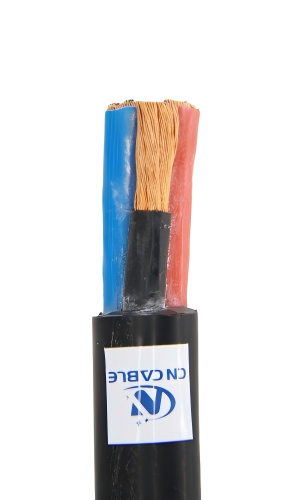
At a 16 mm² cross-section, a Class 5 conductor is made of at least 196 individual fine wires, compared to the 7 thick strands often found in a Class 2 conductor. These fine wires act like a mechanical shock absorber. When bent, the hundreds of fine wires simply slide over one another, absorbing the strain instead of passing it to the insulation.
Because of this architecture, the minimum bending radius for RV-K drops to just 5 times its outer diameter. In a cramped corner where a 4x150 mm² N2XY needs 600 mm of clear space to bend safely, an equivalent RV-K needs only about 250 mm.
Feature | N2XY (Fixed Installation) | RV-K (Flexible Installation) |
Conductor Type | IEC 60228 Class 2 (Rigid) | IEC 60228 Class 5 (Fine-strand) |
Min. Bending Radius | 12 × OD | 5 × OD |
Vibration Resistance | Low (Stress concentrates on thick strands) | High (Fine strands absorb vibration) |
Best Used For | Straight cable trays, open trenches | Switchgear cabinets, vibrating machines |
Stick with N2XY when:
Your routing path is a straight cable tray, a long underground duct, or a wide sweep. N2XY has excellent tensile strength, costs less per meter, and does the job perfectly when it has room to bend.
Switch to RV-K when:
l Space is tight: You are routing inside a switchgear cabinet with 90-degree corners and less than 12xOD clearance.
l Vibration is present: Connecting to pumps, fans, or compressors. The thick strands of N2XY will eventually suffer from metal fatigue under constant vibration, while RV-K’s fine strands distribute the stress.
l Terminal space is restricted: Stiff N2XY cables push hard against terminal lugs, while RV-K’s flexibility relieves the mechanical load on your connections.
The bottom line is: The engineering error isn't choosing N2XY—the error is forcing it into a routing space it was never designed to handle.
Can I use N2XY cable in a control cabinet?
Only if you can maintain the 12xOD bending radius. If the cabinet space is too tight and forces the cable to bend sharply, you risk latent insulation damage. In tight cabinets, RV-K is the safer specification.
What happens if I bend an N2XY cable slightly tighter than its rated radius?
You introduce mechanical stress to the XLPE insulation. The damage is usually invisible. It might pass an insulation resistance test at installation, but over time, the micro-cracks can lead to premature failure.
Why is RV-K recommended for vibrating equipment?
Vibration causes constant flexing at the connection point. N2XY's thick strands concentrate this stress and can snap over time (flexural fatigue). RV-K's fine wires slide against each other, absorbing the vibration and preventing the conductor from cracking.
Is RV-K more expensive than N2XY?
Yes, the manufacturing process for a Class 5 fine-strand conductor is more complex. However, on a project level, RV-K reduces installation time and avoids the need to re-route cables in tight spaces, often offsetting the initial price difference.
Struggling with cable routing in a tight space? Send us your cable size, installation environment, and available bending clearance. Our engineering team can help you choose between N2XY and RV-K, ensuring your installation meets safety and performance standards.
Tel: +86-371-6054 7601
WhatsApp / WeChat: 0086 135 9887 3045
Email: Admin@cncablegroup.com
Previous : Control Cable Shield Grounding: Single-Ended vs. Double-Ended—Why Do Standards "Contradict"?
NEXT : none
inquiry

