
Home >> News >> Company News >>
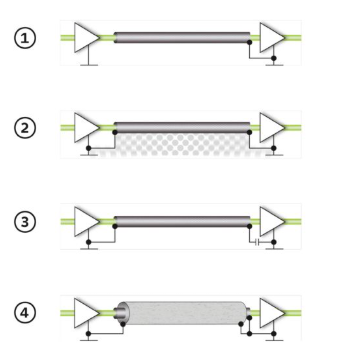 On-site, instrumentation engineers usually require "single-ended" shield grounding to prevent interference, while lightning protection engineers require "double-ended" grounding to discharge lightning. Who should you listen to? Getting it wrong can cause analog signal fluctuations or even interlock malfunctions.
Short Answer: The standards are not contradictory. The single-ended requirement protects against low-frequency ground loops, while the double-ended requirement is intended to discharge high-frequency lightning transients. This conflict only exists on "single-layer shields." The standard itself provides the ultimate solution: when a system requires single-ended grounding, use a double-layer shield—outer shield grounded at both ends for lightning protection, inner shield single-ended to prevent loops.
Instrumentation engineers fear ground potential differences forming circulating currents on the shield, which ruins 4-20mA signals. Lightning protection engineers fear lightning raising the shield potential, which will damage equipment if not grounded at both ends. One protects against "low-frequency steady-state interference," the other against "high-frequency transient destruction."
Forcing both requirements onto a single-layer shielded cable will inevitably cause a conflict. In fact,GB 50057-2010 Clause 6.3.1 does not negate single-ended grounding; it states: "Where the system requires equipotential bonding at only one end, a double-layer shield or steel conduit should be used, with the outer shield or steel conduit bonded at least at both ends." The lightning standard directly provides a structural substitution solution.
Many ask: "I followed the standard and used single-ended grounding, why is my signal still drifting?" Single-ended grounding breaks the ground loop and works well at low frequencies and short distances. But it has a physical frequency limit.
Siemens EMC Installation Guideline explicitly notes that single-sided shield connection "must be applied only for special cases (e.g. only analog systems without digital technology)" and that it "affects exclusively electrostatically against low-frequency capacitive couplings and emissions." At higher frequencies or for long cables, distributed capacitance forms between the floating shield and the ground. High-frequency signals couple directly through this capacitance, turning the floating end into an "antenna" that receives interference, and the shield fails.
Conversely, if you ground both ends directly to the cabinet enclosure, high-frequency interference is discharged, but if there is a potential difference between the grounding grids, a circulating current will flow directly on the shield. This current induces a voltage on the signal lines, which is the culprit for equipment malfunctions.
The only valid condition for double-ended grounding is that both ends are truly equipotential. Siemens documentation confirms this: "In the event of potential differences between ground points, a circulating current may flow through the shield connected at both ends," and recommends installing an additional equipotential bonding conductor. Treating double-ended grounding as a "safer" choice without verifying equipotential conditions is asking for trouble. Before double-ending, measure the ground potential difference. When equipotential is uncertain, single-ended grounding is always the safer default.
Grounding Method | Primary Function | Valid Condition | Failure Risk |
Single-Ended | Breaks low-frequency ground loops | Low frequency, short distance, analog-only systems | Floating end acts as an antenna at high frequencies. |
Double-Ended | Discharges high-frequency transients | Both ends are strictly equipotential | Creates circulating currents if potential difference exists. |
Layered (Double Shield) | Prevents loops AND discharges transients | Inner: single-ended at DCS side. Outer: both ends or one end + equipotential | Inner and outer shields shorted together by mistake. |
Do not memorize grounding methods based on product models; look at the physical limits of the shield structure.
CVV-S copper tape shielded control cable has advantages in low-frequency magnetic shielding, but for long distances or high-frequency interference, single-ended grounding may still leak, and double-ended grounding is limited by the tape's grounding continuity. LiYCY braided shielded control cable uses a tinned copper braid, which has strong high-frequency discharge capability and is structurally designed for grounding, but double-ended grounding in areas with potential differences will also cause interference.
Core Conclusion: As long as it is a single-layer overall shield, you are always forced to choose between "single-ended to prevent loops" and "double-ended to prevent high frequency." When you cannot choose, the problem is not the grounding method, but the number of shielding layers.
When the site has both 4-20mA weak signals, crosses lightning protection zones, and has VFD interference, stop struggling with single-layer cables. Switch to a double-shielded computer cable with individual + overall screens, and solve the problem with physical structure.
The industry standard wiring is clear:
First, inner individual shield (prevents low-frequency loops): Single-ended grounded at the DCS/cabinet side, insulated at the field end.
Second, outer overall shield (prevents high frequency and lightning): Grounded at one end and floating at the other, or grounded at both ends if equipotential is guaranteed.
Third, Golden Rule: The inner and outer shields must remain insulated; they must never be shorted together.
This is the engineering implementation of the IEC 62305-3 equipotential bonding philosophy, which emphasizes equipotential bonding and proper shield termination at both ends for transient protection. If your signal is susceptible to low-frequency interference and requires lightning discharge, specify a double-layer shield structure directly to your supplier instead of compromising on a single layer.
1.Floating end not insulated: The stripped floating shield touches the metal tray, effectively becoming multi-point grounded. This is the most common fault.
2.Pigtail grounding: Twisting the shield into a thin wire and connecting it to a terminal creates huge high-frequency impedance; at high frequencies, it is equivalent to no connection.
3.Daisy-chaining cable shields: Connecting the shields of multiple cables together and grounding them at only one point causes mutual interference and crosstalk.
4.Blind double-ended grounding: Grounding both ends to the enclosure without confirming equipotential at both ends creates artificial circulating currents.
1. Should 4-20mA signal cable shields be single-ended or double-ended grounded?
Default to single-ended. Ground at the DCS/cabinet side, leave the field end insulated and floating. Double-ended is only valid when both ends are strictly equipotential and there is a high-frequency or lightning protection requirement. If equipotential is uncertain, double-ending introduces circulating currents, not protection.
2. GB 50057 requires double-ended grounding, but instrumentation codes require single-ended. Which should I follow?
It depends on the cable's role. For signal integrity against low-frequency loops, follow instrumentation codes for single-ended. For lightning protection zones requiring transient discharge, follow lightning codes for double-ended equipotential bonding. They conflict on single-layer shields; the standard solution is a double-layer shield—outer at both ends, inner single-ended.
3. Is it enough to ground one end of the shield and leave the other floating?
It works for low-frequency short distances, but is not unconditional. At higher frequencies or for long cables, distributed capacitance at the floating end creates a high-frequency path, and the shield cannot maintain actual isolation. Siemens specifies single-ended connection only for "special cases (e.g. only analog systems without digital technology)".
4. Is there a difference in grounding between CVV-S copper tape and LiYCY braided shields?
Yes, but the difference is not about which must be single-ended; it is about how the shield's form affects grounding continuity. Both, as single-layer overall shields, share the same physical boundary: they cannot satisfy both low-frequency single-ended and high-frequency double-ended simultaneously on a single layer.
5. How should the inner and outer shields of a double-shielded computer cable be grounded?
The inner shield is single-ended grounded at the DCS/cabinet side and floating at the field end; the outer shield is grounded at one end and floating at the other, or grounded at both ends if equipotential is guaranteed. The two layers must remain insulated and must not be shorted midway.
Need to select the right shielded grounding structure for your control system? Whether it's standard CVV-S, LiYCY, or a custom individual + overall shielded computer cable, send us your signal type, interference source characteristics, and grounding conditions. Our engineering team can help evaluate the shield structure and provide matching selection advice.
Tel: +86-371-6054 7601
WhatsApp / WeChat: 0086 135 9887 3045
Email: Admin@cncablegroup.com
Previous : Bonded vs. Strippable MV Shielding: The Accessory Mismatch That Stops Your Project
NEXT : none
inquiry

