
Home >> News >> Company News >>
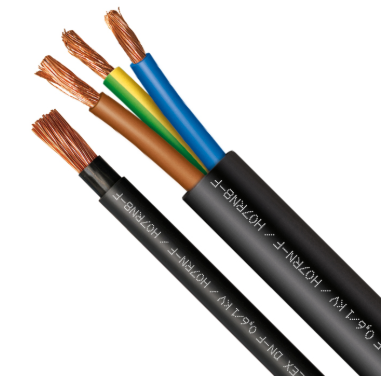 H07RN-F is the most widely used heavy-duty rubber cable under the European harmonised standard. When procurement professionals see this model, two questions come to mind: “Should my project use it?“ and “Is the supplier delivering what they claim?“
This guide covers four technical layers. Each parameter is explained with one clear follow-up: what does this actually mean for procurement?
Technical fact:
H07RN-F uses IEC 60228 Class 5 fine-stranded bare copper conductor — multiple fine copper wires stranded together, not a single solid wire or coarse-stranded conductor. Conductor specification is the first checkpoint for distinguishing genuine H07RN-F.
What this means for procurement:
l If a supplier substitutes Class 2 coarse-stranded conductor for Class 5: The cable will fail after a few hundred bends in a cable carrier. Service life in cranes, cable carriers, and port equipment will drop from years to weeks.
l How to verify: Check the number of individual strands and the maximum DC resistance at 20°C. IEC 60228 specifies exact strand counts and maximum resistance values for each cross-section for Class 5 conductors — these two figures should be directly listed on the supplier‘s data sheet.
Technical fact:
H07RN-F uses EPR (ethylene propylene rubber) insulation. Its long-term allowable operating temperature is 90°C, with short-circuit thermal stability up to 250°C.PVC is rated at 70°C continuous / 160°C short-circuit. The temperature gap directly translates to ampacity. A 20°C margin means that at the same conductor cross-section, EPR-insulated cable carries 15-20% more current than PVC.
What this means for procurement:
l If your project has limited cable tray space or conduit is already sized, EPR cable delivers 15-20% more power without upsizing the conductor.
l Under fault conditions, 250°C vs. 160°C means EPR can withstand approximately 2.5× the fault energy of PVC. For the same short-circuit current, EPR is significantly less likely to fail.
Technical fact:
H07RN-F uses a polychloroprene (PCP/Neoprene) outer sheath. Its performance in oil resistance, weathering, UV resistance, and abrasion is well-documented in industry standards.
What this means for procurement:
l For outdoor projects: PVC sheath powders and cracks within 6-12 months under UV exposure. Polychloroprene lasts 5+ years under the same conditions. Replacement cost — cable + labour + downtime — far exceeds the initial price difference.
l For oily environments: PVC swells and deforms on contact with grease. Polychloroprene does not. In workshops, mines, and ports, this is a hard difference. If PVC is substituted for rubber in an oily environment, the cable may fail within months due to sheath swelling.
l For low-temperature environments: PVC becomes brittle and cracks below -15°C. Polychloroprene remains flexible at -25°C. For winter outdoor construction in northern regions, PVC cable may crack during handling before it‘s even installed.
Based on the material analysis above, here is a direct decision table for procurement:
Project Condition | Choose H07RN-F | Choose PVC | Why |
Frequent bending (cable carriers, drums, cranes) | √ | × | Class 5 conductor + rubber sheath = tens of thousands of bending cycles; PVC fails after hundreds |
Outdoor / UV / rain exposure | √ | × | PCP sheath resists UV, 5+ years life; PVC powders and cracks within 6-12 months |
Oil and grease exposure (workshops, mines, ports) | √ | × | PCP sheath resists oil; PVC swells and deforms on contact with grease |
Low-temperature environment (< -15°C) | √ | × | EPR remains flexible at -25°C; PVC becomes brittle and cracks below -15°C |
Wet / temporary immersion | √ | — | Rubber provides watertight seal; PVC absorbs moisture over time |
Fixed indoor, dry, moderate environment | — | √ | Conditions are mild; PVC is sufficient |
CN Cable Group manufactures H07RN-F heavy-duty rubber cables to IEC 60245-4 and EN 50525-2-21 standards:
Suitable for mobile equipment, construction sites, port machinery, mining, outdoor power supply, ATEX hazardous areas, and more.
For project-specific H07RN-F specification matching, or to verify supplier qualifications, contact us.
Tel: +86-371-6054 7601
WhatsApp / WeChat: 0086 135 9887 3045
Email: Admin@cncablegroup.com
inquiry

